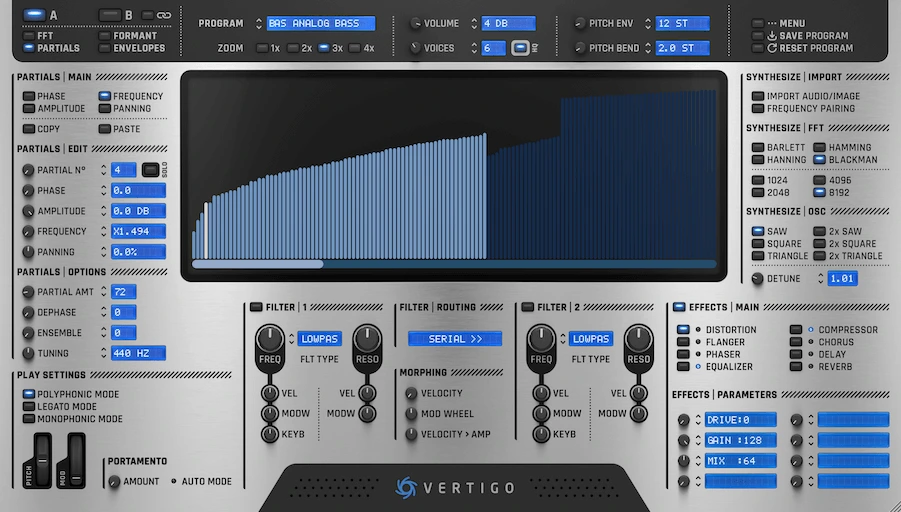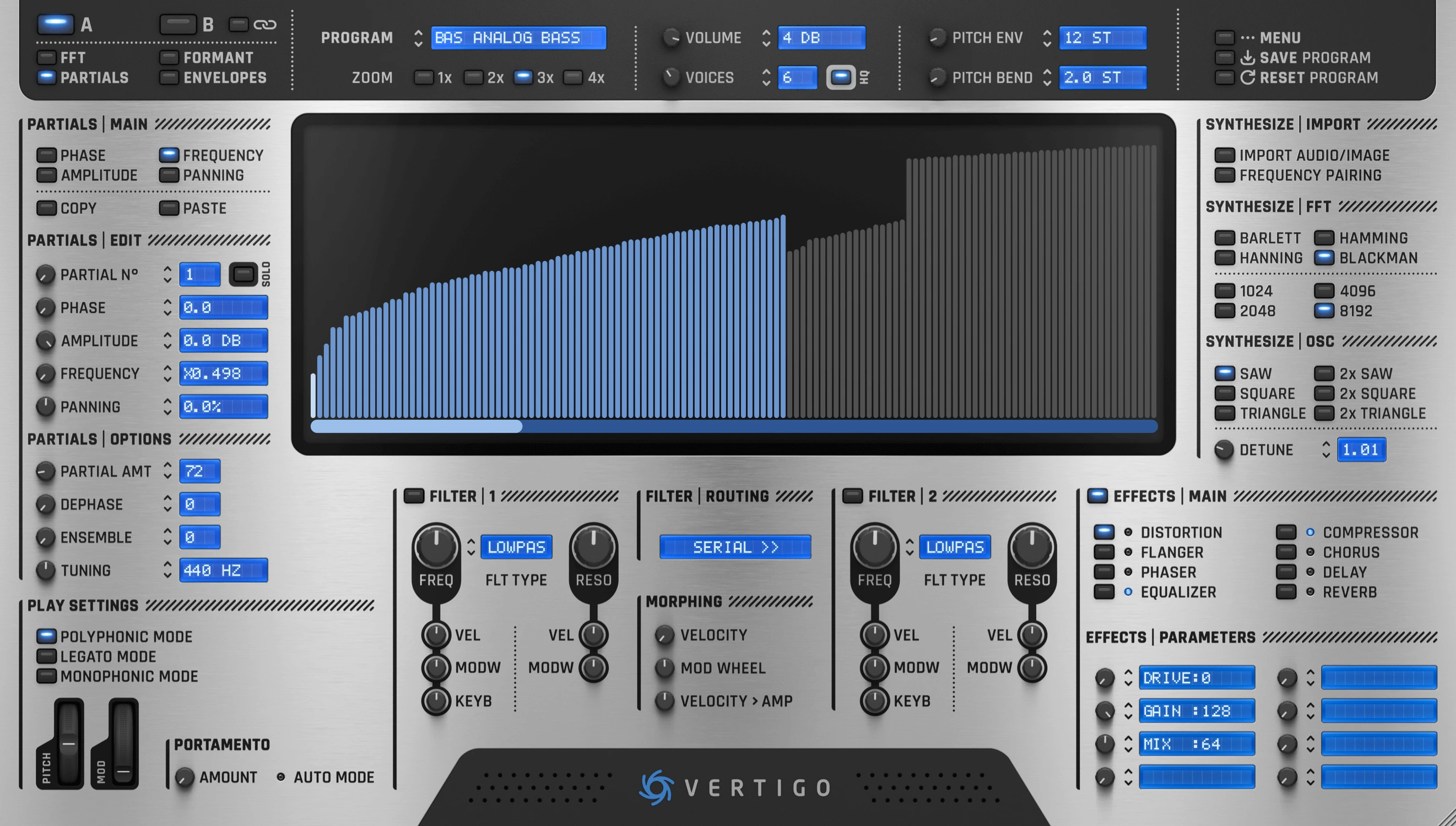
Vertigo is an additive synthesizer with 512 Euler-generated oscillators per voice (-120 dB noise floor). Resynthesizes audio and image files through FFT analysis. Dual morphable A/B states with 256-breakpoint envelopes per partial (phase, amplitude, frequency). Two filters routable in series or parallel with six filter types, 128-band formant filter, eight effects, 16-voice polyphony, scalable HiDPI GUI.


Additive synthesis based on Fourier analysis: build a sound from individual partials, or analyze an existing audio file and reconstruct it from those partials. Material ranges from drawbar-organ tones to abstract textures that aren't reachable from a subtractive synth.

Up to 512 Euler-generated oscillators per voice, no wavetables. Noise floor sits at -120 dB.
Two parameter states (A/B) per voice, with morphing between them driven by mod wheel, velocity, or automation. Each partial has independent phase, amplitude, frequency ratio, and pan.
Per-partial envelopes go up to 512 breakpoints with parabolic interpolation.

FFT-based: drop a WAV in and Vertigo decomposes it into partials with their amplitude and frequency envelopes. The result plays back as additive synthesis you can edit.
FFT frame sizes 1024 / 2048 / 4096 / 8192. Windowing options Bartlett, Hamming, Hanning, Blackman. Larger frames help with bass-heavy material; smaller frames keep transients.
Frequency Pairing reorders partials between the A and B states so morphing crossfades the closest frequency partners — avoids the artifact pile-up you get when partial 1 in A morphs to partial 1 in B regardless of pitch.

Spectrogram-style editor: amplitude and frequency live on the canvas, edits happen directly there.
Horizontal and vertical fades, boost and cut, and partial-range selection. Behaves like a graphic EQ on the partials, with the underlying additive structure intact.
PNG / JPG import as harmonic templates — pixel rows map to partials, columns to time. Image input as a sound source rather than a metaphor.

Harmonic: integer multiples of the fundamental — drawbar organs, brass.
Odd Harmonic: odd partials only — clarinet-style hollow tones. 1-2 Serial: proportional ratios from the gap between the first two operators — bells and metallic textures.
Combine with the phase and frequency smearing controls to deviate from rigid harmonic relationships.

Two resonant filters, routable in series or parallel, with six selectable types: 4-pole LP, 4-pole HP, 2-pole BP, 4-pole BP, 4-pole notch, 4-pole peak.
Series for subtractive shaping, parallel for splitting bands or building phasing effects. Velocity, keytrack, and mod wheel route to cutoff and resonance.
Dedicated bipolar filter envelopes. The 128-band formant filter handles vowel-like and vocal-character processing.

Eight effects tuned for additive material.
Distortion at 8x oversampling (no aliasing on partials), phaser up to 128 taps, flanger, compressor, 8-band EQ.
Stereo chorus, tempo-synced delay, reverb.

HiDPI throughout, multi-threaded rendering so the GUI stays responsive while 512 partials run.
Spectral display, envelope editor, and per-partial activity meters all visible at once. Zoom for detail work.
Drag-and-drop for audio files and images. Built-in bank browser.

Up to 16 voices, with poly / mono / legato modes. AVX2 on x86, NEON on Apple Silicon — usable with all 512 partials active.
Pitch bend, mod wheel, velocity, and full automation on every parameter.
Zero-delay feedback in the signal path. Standalone app included.
Universal Binary 2: Native Intel and Apple Silicon.
Standalone Application: No additional software required.
ProTools AAX. Apple Audio Unit. Steinberg VST. Steinberg VST3.
Supported Platforms







System Requirements
 Windows 10+. IntelIntel processors with AVX2 support:
 10.14+. Apple Silicon or IntelMacBook Pro: Late 2013+
 Debian 10+. IntelIntel processors with AVX2 support: